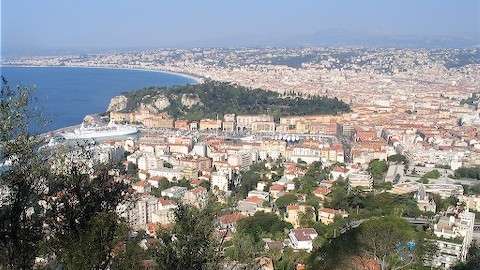
The city is a major tourist centre and a leading resort on the French Riviera (Côte d'Azur).
Perfectly situated on the coast of the Mediterranean Sea and with access to nearby towns of Cannes and the principality of Monaco, Nice proved to be beyond my expectations. I was pleasantly surprised with such a beautiful place in a perfect location. Small enough to wander, strolling along the 8km of beach on the Promenade de ?nglaise lined with hotels, casinos, restaurants and a long pebbled beach.
The old part of Nice are tight alleys and walkways with a large open area with flower market and antiques on hand. Plenty of places to dine or simply taste the great wine of France. Spectacular views of the region can be seen from the easily accessible Parc du Chateau, where one can simply chill in this urban park.
The beaches of Nice consist entirely of stones and pebbles, bring sandals and a cushion, if you want to sit. Showers are provided on all public beaches. The beautiful light blue sea is perfect for a swim rather than playing in the water as the beach drops quickly and the tidal pull can be very strong, and not for beginners.
A visit to nearby Èze is highly recommended, this medieval village with its narrow lanes at the top of a hill overlooking the sea. Nearby is a perfume factory, Fragonard, where one learns the production techniques of creating scents for and the art of being a Nose.
Over all, Nice is a perfect break with plenty to do or simply to relax by the sea.
Video of Nice France 2007 © Joe Mendonca
In southern France located on the Mediterranean coast, the city is nicknamed Nice la Belle, which means The Beautiful Nice. It is the capital of the French Riviera (Côte d'Azur), making it the 5th largest city of France. The area of today's Nice is believed to be among the oldest human settlements in the world.
The first known human settlements in the Nice area date back approximately 400,000 years, the Terra Amata archeological site shows one of the earliest uses of fire and construction of houses and flint findings. Nice was probably founded around 350 BC, established by the ancient Greeks. During the Middle Ages, Nice participated in the wars and history of Italy. As an ally of Pisa it was the enemy of Genoa. During the course of the 13th and 14th centuries the city fell more than once into the hands of the Counts of Provence and in 1388 the commune placed itself under the protection of the Counts of Savoy. In 1561 Emmanuel Philibert, Duke of Savoy, abolished the use of Latin as an administrative language and established the Italian language as the official language of government affairs in Nice.
In 1543, Nice was attacked by the united Franco-Ottoman forces, in the Siege of Nice, though the inhabitants repulsed the assault which succeeded the terrible bombardment, they were ultimately compelled to surrender. In 1600, Nice was briefly taken by the duke of Guise, by the opening the ports of the county to all nations, and proclaiming full freedom of trade, the commerce of the city was given great stimulus. Captured by Nicolas Catinat in 1691, Nice was restored to Savoy in 1696, but it was again besieged by the French in 1705, and in the following year its citadel and ramparts were demolished. In the peaceful years which followed the "new town" was built. In 1775 the king, who in 1718 had swapped his sovereignty of Sicily for the Kingdom of Sardinia, destroyed all that remained of the ancient liberties of the commune. Conquered in 1792 by the armies of the First French Republic, the County of Nice continued to be part of France until 1814, but after that date it reverted to the Kingdom of Sardinia-Piedmont. By a treaty concluded in 1860 between the Sardinian king and Napoleon III, the County was again ceded to France as a territorial reward for French assistance in the Second Italian War of Independence against Austria.
As war broke out in September 1939, Nice became a city of refuge for many displaced foreigners, notably Jews fleeing the Nazi progression into Eastern Europe. From Nice many sought further shelter in the French colonies, Morocco and North and South America.
After November 1942 and the arrival of Italian troops occupying the city. After some resistance, the Italians surrendered in 1943 when the German armies occupied. Nice was heavily bombarded by the American aviation in preparation for the Allied landing in Provence and famine ensued in the course of the summer of 1944. Finally American paratroopers entered the city on August 30, 1944 and Nice was finally liberated.
In the second half of the 20th century, Nice enjoyed an economic boom primarily driven by tourism and construction. The city experienced extensive urban renewal, the arrival of the refugees from Algeria after 1962 independence gave the city a boost and changed somewhat the make-up of its population and traditional views.
Photos of Nice France 2007 © Joe Mendonca