Azores
Ponta Delgada
Nicknamed "The Green Island", it is the largest and most populous of the Azores Islands archipelago belonging to Portugal.

Settled in 1439, São Miguel is 64 km from east to west, and between 8 and 14 km wide. Nicknamed the "Green Island" (Ilha Verde), it is largely covered with fields and meadows in the lowlands. The ancient forest has mostly been replaced by cultivated fields and imported trees and plants. There are hot springs (caldeiras) located in the center of the island, in the area stretching from Povoação to Nordeste.

São Miguel in 1427 became the second of the Azores islands to have a Portuguese settlement. Believed to be discovered between 1426 and 1439, Henry the Navigator authorized the settlement of the Azores by people from Estremadura, Alto Alentejo, Algarve and Madeira through a Carta Régia (a letter from the king describing how things should be). People from other countries also arrived, notably French people and cultural minorities such as Jews and Moors. Since the first settlement, pioneers applied themselves to the area of agriculture.

In 1522 Vila Franca do Campo, then the capital of the island, was devastated by a landslide caused by an earthquake which killed about 5,000 people, and the capital was moved to Ponta Delgada. After this tragedy, the development of the population of Ponta Delgada grew, becoming the new capital in 1546.

With the Portuguese Restoration War of 1640, the island regained its position as a commercial center, getting new contacts with Brazil, which was heavily colonized during this period. Some of the island’s historic buildings, including mansions and churches, date from the 18th century, architectural expansion was due to large profits earned from the production of oranges for exportation, whose main market was Great Britain.

New crops such as tea, pineapple, and tobacco were introduced. The location, climate and fertile soil led to a rapid economic development. The island also became the site of military garrisons and was a commercial center for trade with Africa. It was also a center for the production of sugar and orchil, a dye exported to Flanders. The development of the fishing industry and the improvement of agricultural products helped to boost the economy. Currently, the island is one of the political-administrative centers and it is in São Miguel Island where the headquarters of the government of the Azores is.

Sete Cidades

This is the largest of the islands and points of interest include Lagoa das Sete Cidades where legend claims of the lost city of Atlantis is lost beneath the sea and in the lakes, one blue and the other green. Lagoa das Furnas, an active caldera with steam vents, mud pots and geysers, locals cook food in earth ovens available in picnic areas. Lagoa da Fogo (Fire Like) is a beautiful caldera lake high up in the mountain and know for it's dramatic views and white sand beach.

The highest elevation on São Miguel is the Pico da Vara at 1,103 m. Lying at the eastern end of the island, it is the focus of a Special Protection Area containing the largest remnant of laurisilva forest on the island, which is home to the endemic and critically endangered bird, the Azores Bullfinch.

Lagoa da Furnas Lagoa da Furnas

São Miguel doesn't have a lot of "beaches"; much of the shore is rough cliffs. Around the eastern edge, it is especially steep.

Achada, Sao Miguel, Azores, Portugal

I originate from São Miguel Island, the northwest region in the town of Achada (shown to the left) in Nordeste, born in Ribeira Grande, the second largest city on the island.

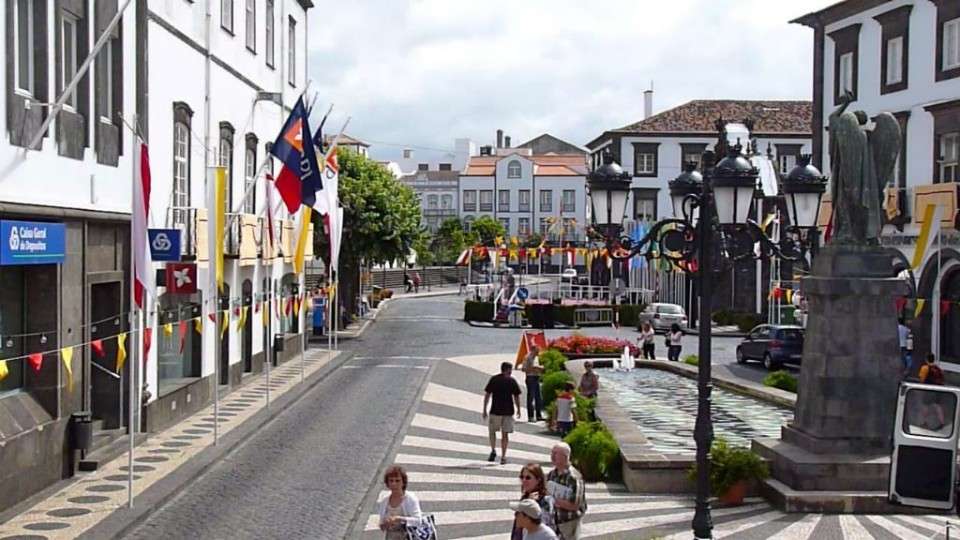
Ponta Delgada
Ponta Delgada

Ponta Delgada received its city status in 1546, is the capital of the island and location of the main airport, as well as the main economic center of the island.

Villa Franco do Campo

The first capital of the island was Vila Franca do Campo, which was devastated by a major earthquake in 1522.

Ribeira Grande
Ribeira Grande

The second largest city on São Miguel is the gateway to the north and 20 minutes away from Ponta Delgada. It is known for its beautiful historic center and the northern beaches known for windsurfing, as well as being one of better access points to Lagoa do Fogo crater lake.

Achada
Achada

Achada is a parish in the district of Nordeste on the island with a land area of 11.19 km² and a population of 503 (2001), it is also, home to my roots.

Azores flag
São Miguel Island
Portugal   Flag
Country Portugal
Location Atlantic Ocean
Archipelago Azores
Area 759 km2 (293 sq mi) 
Length 72.34 km (44.95 mi)
Population 126,000 (2003)
Capital city Ponta Delgada
Currency Euro