Madrid is the capital and largest city of Spain, best known for its great cultural and artistic heritage, and boasts some of the liveliest nightlife in the world.
It is the pumping heart of Spain where the seat of government, and residence of the Spanish monarch, the political centre of Spain. Due to its economic output, standard of living, and market size, Madrid is considered the major financial centre of the Iberian Peninsula. While Madrid possesses a modern infrastructure, it has preserved the look and feel of many of its historic neighbourhoods and streets.
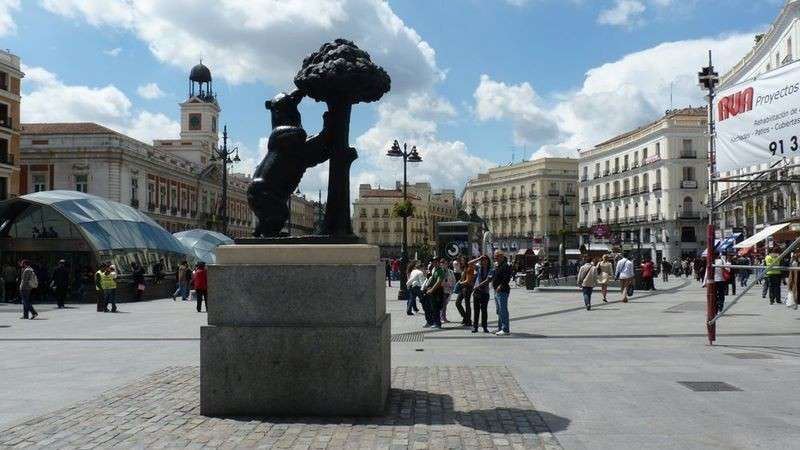
The origin of the name “Madrid” may originate from the name of the city as Ursaria, “land of bears”in Latin, due to the high number of these animals that were found in the adjacent forests, which, together with the strawberry tree, “madroño” in Spanish, have been the emblem of the city from the Middle Ages.
Madrid pulses like no other spanish city, its national veins start here. I was pleasantly surprised to find so many pedestrian ways for such a large city, it is a great city to explore by simply walking from site to site. The central point is Puerta del Sol, a square with fountains and landmarks like the symbol of the city, the bear and strawberry tree, along with ‘km 0’ , a plague on the pavement in front of the city building facing the square. From here, roads branch out along pedestrian walkways in all directions, its a great starting point.
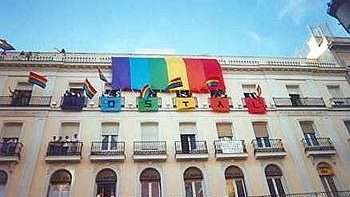
Notable for its nightlife and night clubs, but for this you need to train yourself to avoid going out too early, like elsewhere in Spain, dinner starts at 10 or later, and clubs don't open till at least 3am. The practice of meeting in parks or streets with friends and drinking alcohol together is also popular before going out. Night destinations include the neighbourhoods of Bilbao, Tribunal, Alonso Martinez or Moncloa, together with Puerta del Sol area (including Opera and Gran Via) and Huertas (barrio de Las Letras). The district of Chueca has also become a hot spot specially for gay population, popularly known as the gay quarter.
Madrid hosts the largest Plaza de Toros (bullring) in Spain, Las Ventas, established in 1929, considered by many to be the world centre of bullfighting and has a seating capacity of almost 25,000.
The culture of Madrid was dominated by its religious and Royal history. Enormous, monolithic cathedrals and churches are plentiful in Madrid, as well as medieval architecture, although nowadays Madrid is just as much a cosmopolitan city as Berlin or London, full of new architecture, life style and culture. Madrid has a very modernized and elaborate transportation network of buses and Metro. Like most large cities, however, there is a substantial population of vagrants and beggars lining the streets.
Video of Madrid Spain 2010 © Joe Mendonca
Museo del Prado, one of the finest art collections in the world and the best collection of classical art in Madrid, but despite all the oompha about it, I personally wasn't impressed.
Reina Sof?a National Museum and Art Center, houses Madrid's best collection of modern art including many of Pablo Picasso's works including the renowned Guernica.
Thyssen-Bornemisza Museum of Art, contains a large art collection including masterpieces by Monet, Goya, Degas, Renoir, Van Gogh, Picasso, Mondrian, Bacon and Lichtenstein.
National Archeology Museum, a collection of archaeological finds from across the peninsula, it leaves the visitor with a sense of the chronology of civilization in Spain (Iberian, Phoenician, Greek, Roman, Visagoth, Arab, and into the modern age).
Palacio Real, The Palacio Real (Royal Palace) is an enormous palace, in spite of its name, the palace is not the residence of the current royal family, considered to be one of the most emblematic and beautiful buildings in Madrid. The fa?ades of the palace measure 130 meters long and 33 meters high with 870 windows and 240 balconies opening on to the facades and courtyard. It has a surface area of 100,000 square meters with 44 stairways and more than 30 principal rooms.
Plaza Mayor is the best known plaza in Madrid, this impressive square is now one of the main stops on any tourist visit. Originally built outside the city walls, this square has played host to bullfights, markets, symphonies, tournaments and executions. The statue of Felipe II sits in the middle across from the beautifully painted Casa de la Panadería, the former headquarters of the bakers guild.
Puerta del Sol is the "heart" of Madrid and one of the busiest places in the city. On the north side of the plaza there is a famous statue of an oso (bear) climbing the madroño tree, which is the symbol of Madrid. The giant neon Tío Pepe sign above the plaza is also a famous fixture of this area. New Year's celebrations are broadcast from Sol every year with the ringing of the clock bringing in the new year.
Atocha RENFE, a large train station across the street from the Reina Sofia Museum of Art. The interesting thing about it is the palm garden inside the old building, complete with a pond full of small turtles. It's free, and very much worth visiting.
El Retiro, considered to be the "Central Park" of Madrid, the perfect place to take a rest during a sunny day. There is a large boating lake where one can hire a rowing boat. There is a monument to the victims of the Madrid 3/11 terrorist bombings, the Forest of the Absent, and the Crystal Palace, a large structure entirely made of glass.
Gran V?a, literally "Broadway", is one of the busiest avenues in Madrid, what you could call the main street of Madrid, and the location of the cinema district and has a constant buzz of traffic and life.
Plaza de España, contains a sculpture of Cervantes and his famous Don Quixote and Sancho Panza characters.
Templo de Debod, free to enter, is an Egyptian temple, located in one of Madrid?s most beautiful parks, a present given to Spain for its role in saving the temple of Abu Simbel from the floodwaters of Lake Nasser following the construction of the Aswan Dam in southern Egypt.
CaixaForum, a Cultural Centre with free exhibitions and functions, the building appears to float next to a vertical garden.
There are archeological remains of a small village during the visigoth epoch, whose name might have been adopted later by Arabs. The origins of the modern city come from the 9th century, when Muhammad I ordered the construction of a small palace in the same place that is today occupied by the Palacio Real. Around this palace a small citadel was built. Near that palace was the Manzanares, which the Muslims called al-Majrït, “source of water”. From this came the naming of the site as Majerit, which later evolved into the modern-day spelling of Madrid.
The citadel was conquered in 1085 and reconsecrated the mosque as the church of the Virgin of Almudena. After troubles and a large fire, Henry III of Castile (1379?1406) rebuilt the city and established himself safely fortified outside its walls in El Prado. The grand entry of Ferdinand and Isabella to Madrid heralded the end of strife between Castile and Aragon, and an end to the Golden Age of Jews in Spain. The Crown of Castile, with its capital at Toledo, and the Crown of Aragon, with its capital at Barcelona, were welded into modern Spain by the Catholic Monarchs Queen Isabella of Castile and King Ferdinand II of Aragon. Though their grandson Charles I of Spain favoured Seville, it was Charles' son, Philip II who moved the court to Madrid in 1561. Although he made no official declaration, the seat of the court became the capital. Seville continued to control commerce with Spain's colonies, but Madrid controlled Seville.
During the Siglo de Oro (Golden Century), in the 16th/17th century, Madrid bore little resemblance to other European capitals, as the population of the city was economically dependent on the business of the court itself, and there was no other significant activity.
In the late 1800s, Isabel II could not suppress the political tension that would lead to yet another revolt, the First Spanish Republic. This was later followed by the return of the monarchy to Madrid, then the creation of the Second Spanish Republic, preceding the Spanish Civil War. Madrid was one of the most heavily affected cities of Spain by the Civil War (1936?1939). It was during the Civil War that Madrid became the first European city to be bombed by airplanes specifically targeting civilians in the history of warfare. During the dictatorship of Francisco Franco, especially during the 1960s, the south of Madrid became very industrialized, and there were massive migrations from rural areas of Spain into the city. After the death of Franco, emerging democratic parties accepted King Juan Carlos I as both Franco's successor and as the heir of the historic dynasty - in order to secure stability and democracy. This led Spain to its current position as a constitutional monarchy, with Madrid as capital.
Photos of Madrid Spain 2010 © Joe Mendonca