Joe Journeys
San Francisco
San Francisco Seal
Well-known for its liberal community, hilly terrain, Victorian architecture, scenic beauty, summer fog, and great ethnic and cultural diversity. San Francisco is the financial, cultural, and transportation center of the San Francisco Bay Area. It is the second-most densely populated city in the United States after New York City.

In 1776, colonists from Spain established a fort at the Golden Gate and a mission named for Francis of Assisi on the site. The California Gold Rush in 1848 propelled the city into a period of rapid growth, transforming it into the largest city on the West Coast at the time. After three-quarters of the city was destroyed by the 1906 earthquake and fire, San Francisco was quickly rebuilt, hosting the Panama-Pacific International Exposition nine years later. During World War II, San Francisco was the port of embarkation for service members shipping out to the Pacific Theater. After the war, the confluence of returning servicemen, massive immigration, liberalizing attitudes, and other factors led to the Summer of Love and the gay rights movement, cementing San Francisco as a center of liberal activism in the United States.

History

The Yelamu group of the Ohlone people resided in several small villages when a Spanish exploration party arrived on November 2, 1769, the first documented European visit to San Francisco Bay. Seven years later the Spanish established the Presidio of San Francisco, followed by a mission, Mission San Francisco de Asís.

Upon independence from Spain in 1821, the area became part of Mexico. Under Mexican rule, the mission system gradually ended and its lands began to be privatized. In 1835, Englishman William Richardson erected the first independent homestead, near a boat anchorage around what is today Portsmouth Square. Together with Alcalde Francisco de Haro, he laid out a street plan for the expanded settlement, and the town, named Yerba Buena, began to attract American settlers. Commodore John D. Sloat claimed California for the United States on July 7, 1846, during the Mexican-American War, and Captain John B. Montgomery arrived to claim Yerba Buena two days later and was renamed San Francisco on January 30 of the next year, and Mexico officially ceded the territory to the United States at the end of the war.

The California Gold Rush brought a flood of treasure seekers, raising the population from 1,000 in 1848 to 25,000 by December 1849. California was quickly granted statehood, and the U.S. military built Fort Point at the Golden Gate and a fort on Alcatraz Island to secure the San Francisco Bay. Silver discoveries further drove rapid population growth with hordes of fortune seekers streaming through the city, lawlessness was common, and the Barbary Coast section of town gained notoriety as a haven for criminals, prostitution, and gambling.

Video of San Francisco USA 2011 © Joe Mendonca

Entrepreneurs sought to capitalize on the wealth generated by the Gold Rush. Early winners were the banking industry which saw the founding of Wells Fargo in 1852 and the Bank of California in 1864. Development of the Port of San Francisco and the establishment in 1869 of overland access to the Eastern U.S. rail system via the newly completed Pacific Railroad helped make the Bay Area a center for trade. Catering to the needs and tastes of the growing population, Levi Strauss opened a dry goods business and Domingo Ghirardelli began manufacturing chocolate. Immigrant laborers made the city a multi culture, with Chinese railroad workers creating the city's Chinatown quarter.

The first cable cars carried San Franciscans up Clay Street in 1873. The city's sea of Victorian houses began to take shape, and civic leaders campaigned for a spacious public park, resulting in plans for Golden Gate Park. San Franciscans built schools, churches, theaters, and all the hallmarks of civic life. The Presidio developed into the most important American military installation on the Pacific coast. By the turn of the century, San Francisco was a major city known for its flamboyant style, stately hotels, ostentatious mansions on Nob Hill, and a thriving arts scene.

At 5:12 am on April 18, 1906, a major earthquake struck San Francisco and northern California. As buildings collapsed from the shaking, ruptured gas lines ignited fires that would spread across the city and burn out of control for several days. With water mains out of service, the Presidio Artillery Corps attempted to contain the inferno by dynamiting blocks of buildings to create firebreaks. More than three-quarters of the city lay in ruins, including almost all of the downtown core. Contemporary accounts reported that 498 people lost their lives, though modern estimates put the number in the several thousands. More than half the city's population of 400,000 were left homeless. Refugees settled temporarily in make shift tent villages in Golden Gate Park, the Presidio, on the beaches, and elsewhere. Many fled permanently to the East Bay.

Rebuilding was rapid and performed on a grand scale. Rejecting calls to completely remake the street grid, San Franciscans opted for speed. Amadeo Giannini's Bank of Italy, later to become Bank of America, provided loans for many of those whose livelihoods had been devastated. The destroyed mansions of Nob Hill became grand hotels. City Hall rose again in splendorous Beaux Arts style, and the city celebrated its rebirth at the Panama-Pacific International Exposition in 1915.

In ensuing years, the city solidified its standing as a financial capital; in the wake of the 1929 stock market crash, not a single San Francisco-based bank failed. Indeed, it was at the height of the Great Depression that San Francisco undertook two great civil engineering projects, simultaneously constructing the San Francisco – Oakland Bay Bridge and the Golden Gate Bridge, completing them in 1936 and 1937 respectively. It was in this period that the island of Alcatraz, a former military stockade, began its service as a federal maximum security prison, housing notorious inmates such as Al Capone, and Robert Franklin Stroud, The Birdman of Alcatraz. San Francisco later celebrated its regained grandeur with a World's Fair, the Golden Gate International Exposition in 1939–40, creating Treasure Island in the middle of the bay to house it.

During World War II, the Hunters Point Naval Shipyard became a hub of activity, and Fort Mason became the primary port of embarkation for service members shipping out to the Pacific Theater of Operations. The explosion of jobs drew many people, especially African Americans from the South, to the area. After the end of the war, many military personnel returning from service abroad and civilians who had originally come to work decided to stay. The UN Charter creating the UN was drafted and signed in San Francisco in 1945 and, in 1951, the Treaty of San Francisco officially ended the war with Japan.

Urban planning projects in the 1950s and 1960s involved widespread destruction and redevelopment of west side neighborhoods and the construction of new freeways, of which only a series of short segments were built before being halted by citizen-led opposition. The Transamerica Pyramid was completed in 1972, and in the 1980s saw extensive high-rise development downtown. Port activity moved to Oakland, the city began to lose industrial jobs, and San Francisco began to turn to tourism as the most important segment of its economy. The suburbs experienced rapid growth, and San Francisco underwent significant demographic change, as large segments of the white population left the city, supplanted by an increasing wave of immigration from Asia and Latin America. Over this period, San Francisco became a magnet for America's counterculture. Beat Generation writers fueled the San Francisco Renaissance and centered on the North Beach neighborhood in the 1950s. Hippies flocked to Haight-Ashbury in the 1960s, reaching a peak with the 1967 Summer of Love. In the 1970s, the city became a center of the gay rights movement, with the emergence of The Castro as an urban gay village, the election of Harvey Milk to the Board of Supervisors, and his assassination, along with that of Mayor George Moscone, in 1978.

The 1989 Loma Prieta earthquake caused destruction and loss of life throughout the Bay Area. In San Francisco, the quake severely damaged structures in the Marina and South of Market districts and precipitated the demolition of the damaged Embarcadero Freeway and much of the damaged Central Freeway, allowing the city to reclaim its historic downtown waterfront.

During the dot-com boom of the late 1990s, startup companies invigorated the economy. Large numbers of entrepreneurs and computer application developers moved into the city, followed by marketing and sales professionals, changing the social landscape as once-poorer neighborhoods became gentrified. When the bubble burst in 2001, many of these companies folded, and their employees left, although high technology and entrepreneurship continue to be mainstays of the San Francisco economy.

Photos of San Francisco, United States of America 2011 © Joe Mendonca

Geography

Located on the West Coast of the United States at the tip of the San Francisco Peninsula and includes significant stretches of the Pacific Ocean and San Francisco Bay within its boundaries. Several islands—Alcatraz, Treasure Island, and the adjacent Yerba Buena Island, and a small portion of Alameda Island, Red Rock Island, and Angel Island are part of the city. Also included are the uninhabited Farallon Islands, 27 miles (43 km) offshore in the Pacific Ocean. The mainland within the city limits roughly forms a “seven-by-seven-mile square,” a common local colloquialism referring to the city's shape.

San Francisco is famous for its hills. There are more than 50 hills within city limits. Some neighborhoods are named after the hill on which they are situated, including Nob Hill, Pacific Heights, and Russian Hill. Near the geographic center of the city, southwest of the downtown area, are a series of less densely populated hills. Twin Peaks, a pair of hills resting at one of the city's highest points, forms a popular overlook spot. San Francisco's tallest hill, Mount Davidson, is 925 feet (282 m) high and is capped with a 103-foot (31 m) tall cross built in 1934. Dominating this area is Sutro Tower, a large red and white radio and television transmission tower.

The nearby San Andreas and Hayward Faults are responsible for much earthquake activity, although neither physically passes through the city itself. The San Andreas Fault caused the earthquakes in 1906 and 1989. Minor earthquakes occur on a regular basis. The threat of major earthquakes plays a large role in the city's infrastructure development. The city has repeatedly upgraded its building codes, requiring retrofits for older buildings and higher engineering standards for new construction. However, there are still thousands of smaller buildings that remain vulnerable to quake damage.

San Francisco's shoreline has grown beyond its natural limits. Entire neighborhoods such as the Marina and Hunters Point, as well as large sections of the Embarcadero, sit on areas of landfill. Treasure Island was constructed from material dredged from the bay as well as material resulting from tunneling through Yerba Buena Island during the construction of the Bay Bridge. Such land tends to be unstable during earthquakes; the resultant liquefaction causes extensive damage to property built upon it, as was evidenced in the Marina district during the 1989 Loma Prieta earthquake.

Climate

Since it is surrounded on three sides by water, San Francisco's weather is strongly influenced by the cool currents of the Pacific Ocean, which moderates temperature swings and produces a remarkably mild year-round climate with little seasonal temperature variation. Among major U.S. cities, San Francisco has the coldest daily mean, maximum, and minimum temperatures for June, July and August. During the summer, rising hot air in California's interior valleys creates a low pressure area that draws winds from the North Pacific High through the Golden Gate, which creates the city's characteristic cool winds and fog. The fog is less pronounced in eastern neighborhoods and during the late summer and early fall, which is the warmest time of the year.

Because of its sharp topography and maritime influences, San Francisco exhibits a multitude of distinct microclimates. The high hills in the geographic center of the city are responsible for a 20% variance in annual rainfall between different parts of the city. They also protect neighborhoods directly to their east from the foggy and sometimes very cold and windy conditions experienced in the Sunset District; for those who live on the eastern side of the city, San Francisco is sunnier, with an average of 260 clear days, and only 105 cloudy days per year.

Temperatures exceed 75 °F (24 °C) on average only 28 days a year. The dry period of May to October is mild to warm, with average high temperatures of 64–71 °F (18–22 °C) and lows of 51–56 °F (11–13 °C). The rainy period of November to April is slightly cooler with high temperatures of 58–64 °F (14–18 °C) and lows of 46–51 °F (8–11 °C). On average, there are 67 rainy days a year. Snow is rare, with only 10 instances recorded since 1852, most recently in 1976.

Neighborhoods

The historic center of San Francisco is the northeast quadrant of the city bordered by Market Street to the south. It is here that the Financial District is centered, with Union Square, the principal shopping and hotel district, nearby. Cable cars carry riders up steep inclines to the summit of Nob Hill, once the home of the city's business tycoons, and down to Fisherman's Wharf, a tourist area featuring Dungeness crab from a still-active fishing industry. Also in this quadrant are Russian Hill, a residential neighborhood with the famously crooked Lombard Street, North Beach, the city's Little Italy, and Telegraph Hill, which features Coit Tower. Nearby is San Francisco's Chinatown, established in the 1840s.

The Mission District was populated in the 19th century by Californios and working-class immigrants from Germany, Ireland, Italy and Scandinavia. In the 1910s, a wave of Central American immigrants settled in the Mission and, in the 1950s, immigrants from Mexico began to predominate. In recent years rapid gentrification has spread, primarily along the Valencia Street corridor, which is strongly associated with modern hipster sub-culture. Haight-Ashbury, famously associated with 1960s hippie culture, later became home to expensive boutiques and a few controversial chain stores, although it still retains some bohemian character. Historically known as Eureka Valley, the area now popularly called the Castro is the center of gay life in the city.

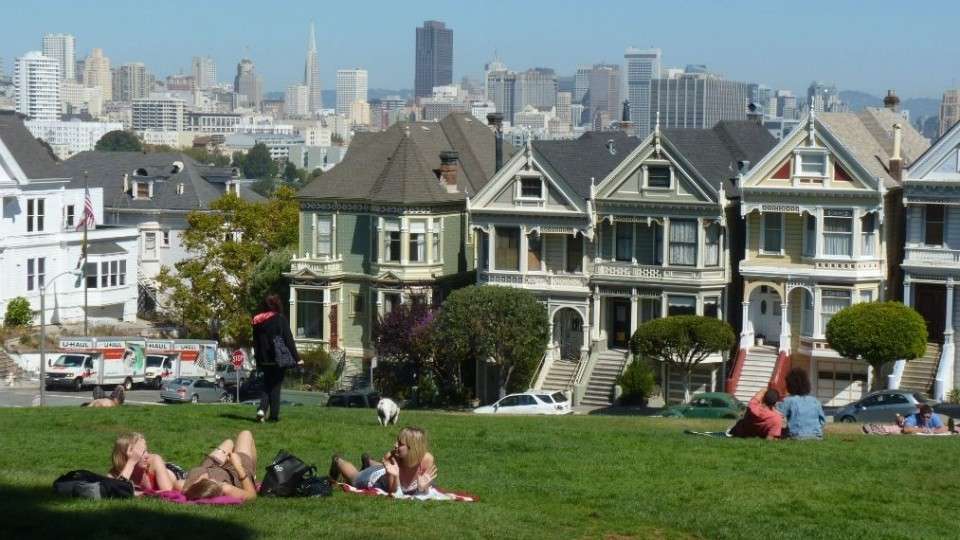
The city's Japantown district suffered when its Japanese American residents were forcibly removed and interned during World War II. The nearby Western Addition became established with a large African American population at the same time. The “Painted Ladies”, a row of well-restored Victorian homes, stand alongside Alamo Square, and the mansions built by the San Francisco business elite in the wake of the 1906 earthquake can be found in Pacific Heights. The Marina to the north is a lively area with many young urban professionals.

The Richmond, the vast region north of Golden Gate Park that extends to the Pacific Ocean, has a portion called “New Chinatown” but is also home to immigrants from other parts of Asia and Russia. South of Golden Gate Park lies the Sunset with a predominantly Asian population. The Richmond and the Sunset are largely middle class and, together, are known as The Avenues. These two districts are each sometimes further divided into two regions: the Outer Richmond and Outer Sunset can refer to the more Western portions of their respective district and the Inner Richmond and Inner Sunset can refer to the more Eastern portions. Bayview-Hunters Point in the southeast section of the city is one of the poorest neighborhoods and suffers from a high rate of crime, though the area has been the focus of controversial plans for urban renewal.

The South of Market, once filled with decaying remnants of San Francisco's industrial past, has seen significant redevelopment. The locus of the dot-com boom during the late 1990s, by 2004 South of Market began to see skyscrapers and condominiums dot the area. Following the success of nearby South Beach, another neighborhood, Mission Bay, underwent redevelopment, anchored by a second campus of the University of California, San Francisco. Just southwest of Mission Bay is the Potrero Hill neighborhood featuring sweeping views of downtown San Francisco.

Beaches and parks

Several of San Francisco's parks and nearly all of its beaches form part of the regional Golden Gate National Recreation Area, one of the most visited units of the National Park system in the United States with over 13 million visitors a year. Among the GGNRA's attractions within the city are Ocean Beach, which runs along the Pacific Ocean shoreline and is frequented by a vibrant surfing community, and Baker Beach, which is located in a cove west of the Golden Gate and part of the Presidio, a former military base. Also within the Presidio is Crissy Field, a former airfield that was restored to its natural salt marsh ecosystem. The GGNRA also administers Fort Funston, Lands End, Fort Mason, and Alcatraz. The National Park Service separately administers the San Francisco Maritime National Historical Park – a fleet of historic ships and waterfront property around Aquatic Park.

There are more than 200 parks maintained by the San Francisco Recreation and Parks Department. The largest and best-known city park is Golden Gate Park, which stretches from the center of the city west to the Pacific Ocean. Once covered in native grasses and sand dunes, the park was conceived in the 1860s and was created by the extensive planting of thousands of non-native trees and plants. The large park is rich with cultural and natural attractions such as the Conservatory of Flowers, Japanese Tea Garden and San Francisco Botanical Garden. Lake Merced is a fresh-water lake surrounded by parkland and near the San Francisco Zoo, a city-owned park that houses more than 250 animal species, many of which are designated as endangered. The only park managed by the California State Park system located principally in San Francisco, Candlestick Point was the state's first urban recreation area.

Culture and contemporary life

In recent years, the wealth resulting from the IT boom from the nearby Silicon Valley, as well as from the recent Dot-Com booms has created a high standard of living in San Francisco, attracting white-collar workers to San Francisco from all over the world. Many neighborhoods that were once blue-collar, middle, and lower class have been gentrifying, as many of the city's traditional business and industrial districts have experienced a renaissance driven by the redevelopment of the Embarcadero, including the neighborhoods South Beach and Mission Bay. The city's property values and household income have risen to among the highest in the nation, creating a large, and upscale restaurant, retail, and entertainment scene. According to a 2008 quality of life survey of global cities, San Francisco has the second highest quality of living of any U.S. city. Due to the exceptionally high cost of living, many of the city's middle and lower class families have been leaving the city for the outer suburbs of the Bay Area, or for California's Central Valley.

Although the centralized commerce and shopping districts of the Financial District and the area around Union Square are well-known around the world, San Francisco is also characterized by its culturally rich streetscapes featuring mixed-use neighborhoods anchored around central commercial corridors to which residents and visitors alike can walk. Because of these characteristics, San Francisco was rated most walkable city. Many neighborhoods feature a mix of businesses, restaurants and venues that cater to both the daily needs of local residents while also serving many visitors and tourists. Some neighborhoods are dotted with boutiques, cafes and nightlife such as Union Street in Cow Hollow, and 24th Street in Noe Valley. Others are less so, such as Irving Street in the Sunset, or Mission Street in the Mission. This approach especially has influenced the continuing South of Market neighborhood redevelopment with businesses and neighborhood services rising alongside high-rise residences.

The international character San Francisco has fostered since its founding is continued today by large numbers of immigrants from Asia and Latin America. With 39% of its residents born overseas, San Francisco has numerous neighborhoods filled with businesses and civic institutions catering to new arrivals. In particular, the arrival of many ethnic Chinese, which accelerated beginning in the 1970s, has complemented the long-established community historically based in Chinatown throughout the city and has transformed the annual Chinese New Year Parade into the largest event of its kind outside China.

Following the arrival of the “beat” writers and artists of the 1950s, to the societal changes that culminated with the Summer of Love in the Haight-Ashbury district during the 1960s, San Francisco became an epicenter of liberal activism, with Democrats and Greens dominating city politics.

The city's large gay population has created and sustained a politically and culturally active community over many decades, developing a powerful presence in San Francisco's civic life. One of the most popular destinations for gay tourists internationally, the city hosts San Francisco Pride, one of the largest and oldest pride parades.

Museums

The Museum of Modern Art (SFMOMA) houses 20th century and contemporary works of art. It moved to its current building in the South of Market neighborhood in 1995 and now attracts more than 600,000 visitors annually. The Palace of the Legion of Honor holds primarily European antiquities and works of art at its Lincoln Park building modeled after its Parisian namesake. It is administered by Fine Arts Museums of San Francisco, which also operates the de Young Museum in Golden Gate Park. The de Young's collection features American decorative pieces and anthropological holdings from Africa, Oceania and the Americas. Prior to construction of its current copper-clad structure, completed in 2005, the de Young also housed the Asian Art Museum, which, with artifacts from over 6,000 years of history across Asia, moved into the former public library next to Civic Center in 2003.

Opposite the Music Concourse from the de Young stands the California Academy of Sciences, a natural history museum that also hosts the Morrison Planetarium and Steinhart Aquarium. Its current structure, featuring a living roof, is an example of sustainable architecture and opened in 2008. The Palace of Fine Arts, built originally for the 1915 Panama-Pacific Exposition, has since 1969 housed the Exploratorium, an interactive science museum.

Get around

Walking can be an enticing option to get from one neighborhood to another, so long as you are aware of where you are and keep your street smarts-- San Francisco is a city of friendly neighborhoods, but it is also a big city -- be aware of your surroundings and keep in mind the dangers that commonly accompany a city of San Francisco's size. However, streets which often go straight up and down hills may make walking challenging when attempting the uphill portions. Driving can be difficult up and down hills, but make for breathtaking views. There are many stairway walks scattered throughout the city when the streets are too steep. You can find maps that include hiking trails, bikeways, and the grade pitch of all streets marked in varying colors by how steep each segment is, that can help you orient to city walks suitable to your ability and temperament, such as the downloadable map issued by the San Francisco Bicycle Coalition. Note that locals rarely use the designations “street” or “avenue”, even when differentiating the numbered streets and avenues. Numbered roads designated “Street” are located on the east side of the city, south of Market in Downtown, Castro, Noe Valley, and Mission. Numbered roads designated “Avenue” put you in the Richmond and Sunset districts on the west side.

Public Transit

San Francisco has one of the most comprehensive public transportation systems in the United States. Transport services within San Francisco are provided by several bodies, separate organizations and although they have many interchange stations, tickets are not normally transferable across the systems (except for monthly or longer period passes). The major transit systems are:
Muni — Metro subway, streetcars, buses, trolley buses and cable cars within San Francisco proper.
BART — regional subway services in the San Francisco Bay Area.
Caltrain — commuter rail services to San José.
An all day Muni passport good on all Muni services, including Cable Cars, costs $14. Other passports and passes are available for longer periods: a 3-day pass costs $21, while a 7 day pass costs $27. The passports come in the form of scratch cards; be sure to scratch off the appropriate dates before using. (*prices in 2011 rates)

Muni Metro is a modern light rail and subway system. It connects many southern and western neighborhoods to downtown, where you can transfer to one of BART's four downtown stations and the Caltrain terminal. Outside of the Market Street and Twin Peaks subways, Muni Metro operates as a surface light rail system, running in the center of the street with stops every couple of blocks. Tickets can be purchased from ticket vending machines before boarding; if the stop does not have such a machine and you do not have a ticket, you must board through the front door and buy one from the driver or risk being fined by a fare inspector.

The Historic Streetcar F Line uses historic streetcars, in original colors from several cities in the US and Milan, Italy. The line runs from Fisherman's Wharf south along the waterfront Embarcadero to the ferry building at the foot of Market Street, then up Market Street on the surface to the Castro district. Board through the front door and buy tickets from the operator if you do not already have a transfer or pass.

The world-famous Cable Cars run on three lines in the steep streets between Market Street and Fisherman's Wharf: the north-south Powell-Mason and Powell-Hyde lines and the east-west California Street line. These cars are a fun ride, especially if you get to stand on the running board, if a bit impractical for everyday use. The cable car is such an attraction that, especially on weekends, it takes longer to wait in line to ride up Powell Street than it does to walk the short but sloping distance. If you want to save yourself time standing in line at the turnaround, just walk up a couple of blocks to the next stop — the conductors save a few spaces for people boarding along the way; you won't get first choice of seats, but you'll save yourself a long time standing in line. Board through any door or just grab a pole on the running boards; tickets are checked and sold by a uniformed conductor. Do not buy tickets from anyone off the car except for clearly marked ticket booths — scam artists are common.

Other public transportation options include: BART, the regional metro, has eight stations in San Francisco, making it a nice way to get between well-trafficked parts of the city, especially downtown and the Mission. BART gets you across the Bay to Berkeley and Oakland and to the airports of San Francisco and Oakland.

See

There are many highlight walks you can take to really capture the feel of the city and see a whole lot of attractions at the same time. Some of the best ones are:
Chinatown. Grant from Bush to Broadway takes you through the heart of the famous district. Returning by the parallel Stockton or Powell will give you a better feeling of the day to day life of the residents, and are both good for those looking for imported commodities such as tea or herbs.
Ocean Beach. Ocean Beach is entirely open to pedestrians in both the Richmond and Sunset districts from the Cliff House restaurant and Sutro Baths in the north to the zoo in the south. For a shorter walk, the windmills near Lincoln at the end of Golden Gate Park offer a good base for a stroll north.
Telegraph Hill. Greenwich and Filbert Steps on the east side of Telegraph Hill, both strenuous and unforgettably beautiful, offer cottages and a flock of wild parrots to enjoy on the way up to the Coit Tower.
North Beach. Columbus runs from North Point in Fisherman's Wharf, through the grand church and famous cafés at the heart of North Beach to the landmark Transamerica pyramid, accessible to transit on nearby Market.
Haight Ashbury. Haight from Divisadero to Stanyan covers the shopping district famous for hippie culture; at Stanyan the street becomes a path through Golden Gate Park to a popular site (then and now) for relaxing and concerts.
Cow Hollow. Union Street between Gough and Fillmore is one of the finest shopping streets outside of the city center.
Mission. Mission between 15th and Cesar Chavez streets provides a look at a neighborhood famous for its Latino food and culture, as well as occasional gang activity east of Mission Street. Parallel to Mission, Valencia Street is the artery of the many higher end boutiques and offbeat cafés starting to characterize the neighborhood, and has little of the grit of Mission St. 16th Street between Mission and Guerrero Streets offers a diversity of cuisine and several hip bars.
Pacific Heights. Fillmore between Pine and Broadway is lined with a good mix of shopping, views, steep slopes, and some of the city's largest and most expensive homes.
Fillmore. Post from Laguna (near 38 bus stop) to Fillmore takes you through upscale shopping and restaurants in Japantown, and turning left onto Fillmore across Geary and on to Turk takes you past the internationally known jazz venues and a mix of Black and Korean owned shops.
Castro and Noe Valley. Market from Church to Castro St. and a left down Castro St to 19th takes you through the center of the city's famous gay mecca. Continuing up Castro St over the hill from there takes you to 24th St, the main drag of bohemian Noe Valley.

Landmarks

Perhaps the most recognizable landmark in San Francisco and one of the most famous bridges in the world, the Golden Gate Bridge, spanning the Golden Gate, has been called one of the Seven Wonders of the Modern World and is the first thing you see of San Francisco if driving in from the north, as it is one of the major road routes into and out of the city. Overlooking the Golden Gate is the Presidio, a former military post with beautiful architecture and a very scenic park setting. Within the Presidio is the gorgeous Palace of Fine Arts, built for the 1915 Panama-Pacific Exposition and reminiscent of Roman and Greek architecture.

Within the center of the city, the famous cable cars run up and down the hills of San Francisco between Market Street and Fisherman's Wharf and offer quite a ride. Atop one of those hills, Telegraph Hill in North Beach, is Coit Tower, a gleaming white tower dedicated to the San Francisco firefighters. At 275' high, the hill is a healthy hike from the nearby neighborhoods just below. Another prominent tower nearby is the Transamerica Pyramid, the tallest and most recognizable building in the San Francisco skyline, located among the skyscrapers and highrises of the Financial District. Perhaps the most famous view of that skyline is from Alamo Square Park in the Western Addition district, home to the famous Painted Ladies row of Victorian houses, with many other pretty Victorians encircling the lovely park.

Over on Russian Hill is the famous stretch of Lombard Street between Hyde & Leavenworth, the (nearly) crookedest street in America. The city also has a twistier but less scenic stretch of street, Vermont Street on Potrero Hill. Other street oddities in San Francisco include 22nd Street between Vicksburg and Church in Noe Valley and Filbert Street between Leavenworth and Hyde on Russian Hill — At a 31.5% grade, these streets share the honor of the steepest streets in San Francisco.

Neighborhoods

San Francisco is also well-known for its collection of unique and intriguing neighborhoods. Most tourists start with Fisherman's Wharf; although many of the locals consider it a tourist trap, it is a great place to see street entertainers, watch sea lions, visit museums, or take a cruise to the infamous Alcatraz Prison or Angel Island. Working fishing boats still come into the small harbor here, and the district is home to several excellent seafood restaurants. The fresh breeze from the bay can provide a bracing setting.

Chinatown, centered around Grant Street from Bush to Columbus, is part tourist trap, part an exhibit of local life. Good eating places abound, and the side streets especially have stores one wouldn't find in a mall. Stockton Street is where most locals do their shopping for groceries; be sure to sample some of the dim sum and other specialties offered in the many bustling shops. However, many local Chinese prefer to eat and shop in the new Chinatowns located in other neighborhoods such as on Clement Street between 2nd and 12th Avenues in the Inner Richmond neighborhood.

Closer to Downtown is the Civic Center, with its impressive Beaux Arts buildings including City Hall and the War Memorial Veterans Building, the celebrated Asian Art Museum, music and theater venues (including large concert halls and a renowned Symphony and Opera), and the main public library. Nearby, within the highrises of Downtown, Union Square is the heart of the city's main shopping and hotel district, while SoMa to the south is rapidly gentrifying, home to the city's main convention center and several new museums.

To the south of Downtown, at the top of Market Street, is the Castro, the center of San Francisco's Lesbian/Gay/Bi/Transgender (LGBT) community, with numerous theaters and small shops and restaurants. Next door is the Mission District, home to the Mission Dolores Church, one of the oldest structures in the city, and a fantastic collection of murals of all sorts on the walls of many nearby buildings, especially on alleys between Market and Valencia.

Treasure Island, an artificial island half-way between San Francisco and Oakland connected to the Bay Bridge, has excellent views of the San Francisco and Oakland skylines and quirky structures from the international fairground-turned-navy base-turned-neighborhood.

Museums

When the morning is foggy, you may want to spend a few hours in one of the city's many world-class museums. Golden Gate Park is home to the copper-clad M.H. de Young Memorial Museum, which houses an impressive collection of contemporary and indigenous art. The de Young Museum's former Asian collection is now permanently housed in the Asian Art Museum of San Francisco, located in the Civic Center. Across from the de Young Museum stands the California Academy of Sciences, which holds a huge array of science exhibits, including an aquarium and a natural history museum.

The California Palace of the Legion of Honor is in Lincoln Park in the northwest corner of the Richmond district. In Nob Hill, the Cable Car Museum offers exhibits on the famous moving landmarks of San Francisco. Near the Castro is the Randall Museum, a lovely little children's museum. The San Francisco Museum of Modern Art, the Moscone Center, the Yerba Buena Center for the Arts, Zeum, the Cartoon Art Museum, the Museum of the African Diaspora and the Museum of Craft and Folk Art are all located in SoMa, south of Union Square. The Contemporary Jewish Museum, which was designed by Daniel Libeskind and opened in June 2008, is the latest major addition to San Francisco's museum scene.

At the Hyde Street Pier in Fisherman's Wharf you can go on board several historical ships, including the 1886 Balclutha clipper ship, a walking-beam ferry, a steam tug, and a coastal schooner. At Pier 45 just to the east, the World War II submarine USS Pampanito and the World War II Liberty Ship SS Jeremiah O'Brien can be visited. Nearby is the Aquarium of the Bay on Pier 39 and the Wax Museum.

The Exploratorium at the Palace of Fine Arts in the Marina will keep you busy for an entire day with their science and perception exhibits. Also in the Marina district is Fort Mason, home to a few cultural museums.

Parks and outdoors

San Francisco has numerous parks, ranging from the tiny to the huge. The most of famous of them is Golden Gate Park in The Avenues district, a massive (roughly 1/2 mile-by-four mile) urban oasis with windmills, bison, museums, a carousel and much more hidden among its charms. The park contains the antique palatial greenhouse of the Conservatory of Flowers, the modern and ethnic art focused de Young Museum, the large Japanese Tea Garden, the new California Academy of Sciences building designed by Renzo Piano and the Strybing Arboretum, a collection of plants from across the temperate world. Defining the extreme Northwestern corner of the city is Lincoln Park in Richmond, which provides majestic views of the Marin Headlands, the Golden Gate Bridge from the ocean side, and the Pacific Ocean itself. At the extreme western end the well known Cliff House provides both semi-casual and a more formal eating and drinking place. The Legion of Honor museum at the center of the park houses many incredible artworks.

Near the physical center of the city is the Twin Peaks, one of San Francisco's highest points (875' above sea level); providing spectacular views in all directions. Tour buses can get backed up here during the day, but it's a great place to really appreciate the city from above, especially at and after sunset. Temperatures up there can be quite a bit lower than in the rest of the city, so bring a jacket. Nearby in the Lake Merced area is the San Francisco Zoo, a large and well maintained zoo which is a great place to go if you are traveling with children or have a fondness for penguins, primates, lions or llamas.

While not particularly well known for its beaches, San Francisco has a couple of good ones along the Pacific Ocean — but the water is brisk, the winds can be rough, and due to a very strong riptide swimming at any of them is not recommended. Ocean Beach along the Sunset district is the largest and most famous beach, with plenty of sand and people enjoying themselves. China Beach in Richmond and Baker Beach in Golden Gate are smaller, rather secluded beaches with lovely views.

On sunny days hipsters flock to Mission Dolores Park, so named due to its location across the street from the Mission Dolores Basilica. The park often comes to resemble a large party, with music, coolers of beer and, er, uh...medical marijuana treatment. Mission Dolores Park is situated on a slight slope in the Noe Valley neighborhood, just a few blocks from the many restaurants and bars in the Mission. The east side of the park is bounded by Dolores Street, a hilly and scenic drive lined with palm trees and Victorians.

In the southern half of the city is the often overlooked but wonderful Bernal Heights Park, a small park on top of a hill overlooking the entire eastern half of the city, with excellent views of the skyscrapers in the Financial District, the Mission District, and the hills in the southeastern corner of the city. A wide trail runs around the base of the park below the peak which can be walked in ten to fifteen minutes. Bernal Heights Park is dog friendly, so much so that a coyote is often observed there.

Do

One of the best ways to see San Francisco is from the waters of San Francisco Bay. There are many companies offering harbor tours of varying durations and prices but they all provide marvelous views of the bay, the bridges, the island of Alcatraz and the city. Only specific island tours are allowed to land at Alcatraz, but the typical harbor tour will circle the island at a slow crawl, giving you plenty of opportunity to photograph the now-inactive prison from the water.

Also consider taking a ferry from San Francisco across the bay to Tiburon, Sausalito, or Alameda. Same views for a fraction of the price. Most tours leave from docks at Fisherman's Wharf near Pier 39. Tickets can be purchased at kiosks along the waterfront walk. Buy tickets a day or two in advance during the summer high season.

Even on a sunny day the bay can be chilly, so be sure to bring a sweater as well as sun screen.

Stay safe

The areas that one should be most cautious are in the neighborhoods of Bayview-Hunters Point, Visitacion Valley, Sunnydale, Ingleside, and Potrero Hill in Southeast San Francisco, as well as the Tenderloin, parts of Western Addition (including the Fillmore District), and parts of the Mission. San Francisco also has the largest homeless population per capita in the United States. The main homeless area is around 6th and Market, heading towards the Civic Center, and in the Tenderloin. Haight Ashbury also has lots of panhandlers, and the area near Golden Gate Park at the end of Haight Street near McDonalds is notorious for junkies and should be avoided at night.

Verdict

San Francisco is a clourful city to walk and discover. The archictecture is stunning with its victorian houses that at times appear to be built on stilts into the hillside, long stairs leading up to the entrances. It is very green, with impressive views often revealing itself. The city is not particularly large, in fact it can be done in about 3-4 days at a liesurely pace.

Seeing the Golden Gate Bridge is something you may have to try on more than one occasion, as I experienced, where the sun may be shining in the city, the bridge itself is shrouded by a low cloud of fog, it wasn't till my 4th attempt I finally got a good glimps of it, though not from a close distance since I was resticted to time on my last day there.

Its a very liberal city, so much so that walking naked is not illegal, nor was it uncommon. The party starts early in San Francisco so don't plan on waiting too late to out for fun, start dinner early and start the night early, don't expect late outings, or get ready to wait in long ques of lines to enter.

The one thing that becomes very evident is the amount of homeless people in the city, regardless of the neighbourhood, living in cardboad boxes, shopping trollies and buggies filled with lifes possesions. This is possibly the worst thing about San Francisco, it may make you feel uncomfortable at times.

The city centre is dull, high rises, concrete edifices, which at night become less welcoming. Staying in one of the neigbourhoods is a much better option where cafes, restaruants and bars are alive at night. San Francisco is a strange climate, where one moment you may be patting off the sweat, and the next reaching for a sweater or jacket. I wouldn't recomment too much time in the city, a few days enough to explore it all.

If your here for one of the many festivals of the year, including Folsom Festival, which is an eye opener, and not for conservative thinkers, is great fun and a must see.

USA flag
San Francisco
USA Flag
Estabilished June 29, 1776
Country United States of America
State California
Area 231.89 sq miles
(600.6 km2)
Currency $ U.S. Dollar